The Role of Rule-makers
Article
Site map
In 2025, the conversation around circular fashion moved from “Can it work?” to “How do we scale it credibly, consistently, and at the right price?”. At Recover™, our year was defined by that shift: expanding capacity, strengthening partnerships, translating innovation into products, and raising the bar on transparency so brands and suppliers can make confident sourcing decisions.

One of Recover’s most significant 2025 developments was announcing a strategic joint venture with Intradeco to establish the Recover™ Central America Hub, based in El Salvador, with operations starting in 2025. The objective is to expand recycled cotton fiber production closer to the Americas, supporting faster lead times, supply-chain resilience, and the foundations of a regional textile-to-textile ecosystem.
For global brands and retailers, nearshoring and compliance are no longer “nice-to-haves.” The JV is positioned to help simplify sourcing structures for the Western Hemisphere while strengthening supply chain integrity, particularly relevant for stakeholders navigating evolving US compliance expectations. Recover™ also highlighted benefits tied to proximity (to waste streams and manufacturing) as a lever for reducing complexity and emissions.
In October 2025, Recover™ joined the T2T Alliance, a coalition of advanced textile recyclers advocating for progressive policy action to accelerate circularity. The alliance explicitly emphasizes the need for frameworks that enable scale; especially around recycled content, recyclability, and reliable traceability mechanisms. Infrastructure scales circularity; policy accelerates (or stalls) it. 2025 showed that scaling textile-to-textile recycling cotton requires both; industrial capacity on the ground and an enabling environment that rewards credible circular systems.
In late 2025, Recover™ announced a multi-year agreement with H&M to support integration of our recycled cotton fiber, RCotton, in H&M’s products. The partnership builds on product development work that began in early 2024 and is designed to support scaled commercial introduction of mechanically recycled cotton into collections.
For many stakeholders, recycled materials have been trapped in pilots: limited volume, inconsistent quality, or unclear verification. Multi year commitments help change that dynamic creating clearer demand signals and enabling supply-chain partners to invest in capacity, QA, and traceability. These collaborations are proof points that recycled cotton vs organic cotton is not an either/or debate; brands often need a portfolio approach that includes recycled content at scale, supported by verifiable systems.
Recover’s long-running collaboration with Primark has been communicated as part of Primark’s broader sustainability agenda, with Primark stating it has partnered with Recover™ since 2020 to use more recycled cotton in clothing and to support accessibility. For the wider market, this matters because it demonstrates that recycled cotton can appear in mainstream retail contexts helping challenge the assumption that “sustainability is always premium-priced.” For sourcing teams at other brands -and for spinners, weavers, and garment makers- the lesson is practical: if recycled cotton can meet a fast-moving retailer’s constraints on quality, continuity, and cost, it becomes easier to justify adoption in other value segments. That’s how visibility turns into confidence, and confidence turns into scale.


In November 2025, Recover launched Recover™ Fabrics, a new product line for premium, low-impact fabrics accessible to brands of all sizes. The proposition is straightforward: reduce friction in adoption by offering ready-to-specify, performance-led fabrics built on Recover’s recycled cotton fiber.
Recover™ fabrics includes four collections so far -ELITE, PREMIER, CORE, and ESSENTIAL DENIM- covering wovens, knits, and denim staples designed for real world brand needs. For sustainability teams, this is also an adoption unlock: fabric-level offerings can reduce development cycles and help align mills, trims, and compliance requirements earlier in the process.
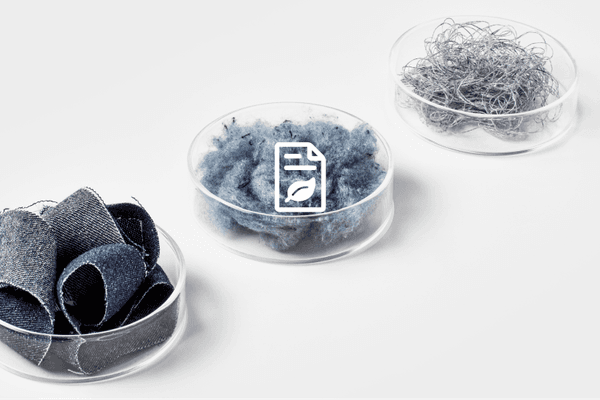
Denim remains one of the most visible places to demonstrate impact at scale. Recover’s portfolio positioning across fabrics and collaborations reinforces how recycled denim fiber and cotton-rich blends can meet aesthetic and durability requirements while moving the needle on circularity. This also connects to a frequent sourcing reality: blended solutions (including recycled cotton blends and polycotton options) can provide the performance and process stability needed for wide distribution.
Beyond industrial production, 2025 also showed what’s possible when circular design principles drive creative decisions. Recover™ highlighted emerging designer Hugo Dumas, a joint winner of the Redress Design Award 2025, whose capsule incorporated Recover™ recycled cotton fiber and emphasized design choices intended to support circularity, including choices that enable easier recycling.

In October 2025, Recover™ and Intradeco were named winners of Textile Exchange’s Climate and Nature Impact Award for Textile-to-Textile Partnership at the Textile Exchange Conference in Lisbon. The award focuses on collaborations that close the loop through commitment, investment, and innovation; helping scale preferred recycled systems and shifting industry practice.
In August 2025, Recover™ was recognized as a dual category winner in the Just Style Excellence Awards 2025 for Business Expansion and Environmental Impact. The feature highlights an expansion strategy built on proximity locating recycling capacity closer to waste sources and manufacturing -and underscores the importance of verified impact claims for credibility-.
Awards are not the strategy, but they can serve as a third-party signal that the underlying strategy is resonating: scale, systems, and measurable outcomes. For brands and retailers evaluating a recycled cotton fiber supplier, these recognition can prompt deeper due diligence: certifications, chain-of-custody documentation, and traceability approaches that protect integrity as volumes grow.

2025 also marked the year we renovated our GRS certification both in Bangladesh and Spain, and obtained it in our newly opened recycling facilities in Vietnam and in El Salvador. The Global Recycled Standard (GRS) is designed to increase use of recycled materials and reduce harm in production, while also addressing social and chemical requirements. It includes chain-of-custody expectations and helps stakeholders validate recycled content claims central to discussions around GRS certified recycled cotton -and, in broader industry practice, RCS-certified claims where applicable-.
Recover™ also communicated achieving ISO 9001 certification, emphasizing the role of quality management systems and external audits in strengthening consistency and continuous improvement; an important layer when recycled inputs must perform reliably in industrial settings.
In June 2025, Recover™ and TextileGenesis launched a pilot to verify supply chain integrity for recycled materials, using Fibercoin™ digital tokens to help trace Recover’s recycled cotton from fiber through to finished garment. Recover™ positioned the pilot as complementary to existing physical tracing and GRS certification, and explicitly linked it to readiness for regulatory developments such as the EU Digital Product Passport. As recycled content becomes more common, so does the risk of inflated or unverified claims. A layered approach: quality systems + chain-of-custody standards + physical and digital traceability—helps protect brands, suppliers, and ultimately consumers. It also reduces friction in reporting and compliance for sustainability teams, especially when products and materials cross multiple geographies.


2025 was a year of turning circular ambition into systems: expanding manufacturing capacity, strengthening brand partnerships, launching products that reduce adoption barriers, earning third-party recognition, and building the transparency infrastructure that protects trust. Each milestone reinforced the same belief: circular fashion becomes “for all” only when it works in real supply chains—at real volumes, with measurable integrity.
As the industry moves into its next phase -where regulation, traceability, and performance expectations converge- Recover™ will keep focusing on what makes circularity scalable: robust recycled cotton fiber production, credible verification, and collaboration across the value chain.
The direction is clear, and we end up 2025 with a strong belief that we are on the right path to achieve our mission of enabling large-scale sustainable change in fashion through business value and inspiration.